21.7.05

It's Between Romainia and the Ukraine.

J just found out that she gets to go to Moldova for work in October. I'm a little green eyed.

but I can't hold it against her because...

tomorrow's our 4 year aniversary!

Year three was a good one. For the first time, we were both working towards something that we like, neither of us were depressed, and life was clicking. Here's to year four. May it be just as great (even if we will only see each other 7 months out of it).

Read more...

19.7.05

Living Through Gentrification

Something kind of strange has been going on around here lately. Our neighborhood has been improving. I think there must be some city money going into beautification, because pretty randomly all of the shops along the main streets replaced their hand painted tarps with actual signs. It’s not just that though, in a few more months, a great big park that will connect the neighborhood to Airport T-Station will open along with an old industrial warehouse that is being converted into a brand spanking new YMCA. The MBTA will be remodeling Maverick Station as well, along with new landscaping at Maverick Square. And it seems like the demographics are changing as well. Taking into account that everyone in Boston moves in May and September, it already seems like there is a huge spike in the student population. These are the people that we know as the “risk-oblivious,” people without kids who can choose wherever they want to to live and have the money and support systems to leave if anything ever gets too bad.

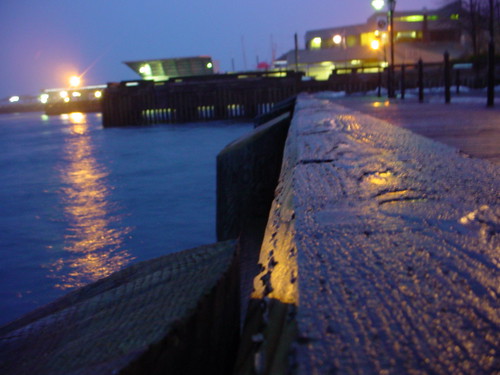
My neighborhood is hundreds of years old. We started out as an island (Noodle Island) and the British had a garrison here. The island was slowly connected by landfill to the town of Winthrop-by-the-Sea and to form the south shore of the Chelsea River. We are surrounded by water on all sides, the Atlantic to the east, Boston Harbour to the south and west and the Chelsea to the north. Development was relatively slow compared to much of Boston, which sprawled south due to geographic constraints. In the eighteen hundreds East Boston became the center of the clipper ship building industry. Housing sprung up for the immigrants (mostly French-Canadian) who came to work on the ships. Development typically followed this pattern: industrial and warehouses two blocks deep along the shore line with housing (typically Victorian triple-deckers) filling up the inside. Over the next hundred years, the Canadians were gradually replaced by Italians and then by Salvadorians. The city used additional landfill on the east side to build Logan International Airport, but other than that, the fabric of the city has remained mostly the same over the last hundred years. At some point in the last ten years, someone realized, “holy crap, there are at least 20 square blocks of unused industrial sites (or brownfields, as it goes in the lingo) that have the best possible views of downtown Boston… and it’s only one subway stop from downtown and the financial district… and it’s cheap as yo mama.”

The city started a few years ago by replacing some old train tracks with parkland right on the harbour, and now the redevelopment is starting. The project that I described in my last post is only the beginning of the new work. One other big example is called “Pier One” (I can’t even write that without imagining Kerstie Alley yelling). It’s a development of 505 luxury apartments, 80 condos, 380 boat slips and 150,000 square feet of restaurants and retail and office space. It’s hard to imagine this without thinking of how it will change the shape of the neighborhood. Although, if anyone has an extra 50 million lying around, I’ve got some great plans for a fish gutting factory.

Gentrification is scary when it happens to your neighborhood. I know my landlords well, and I don’t see them doing anything to make it hard for me to live here, but you have to wonder if you are going to be able to afford to stay in your neighborhood when the professionals start moving in. There are, however, big winners as well. The Italian lady in the building behind me has had her place handed down to her from her grandparents. Her family has owned it for almost 100 years. In a few years she should be able to sell it for four or five times what it was worth a year ago (and in Boston’s housing market, we are probably talking a million.) Not bad for something that your poor immigrant grandma left you.

I think that is the thing about gentrification. Cities go through cycles. Neighborhoods will regenerate and decline. Right now, the inner cities seem to be significantly improving, but at the cost of first and second ring suburbs, especially ones that were built post-war and turned out poor places for communities. In the words of James Howard Kunstler, “To demand an end to these processes would result in the death of the city.” We just need to remember those that are being pushed out.

Read more...

13.7.05

Ausbildung

I got the internship i wanted.

I'm going to be doing research relating to a Hope IV grant for the revitilization of a public housing project for a think-tank called The Center for Urban and Regional Policy (I added a link as well)

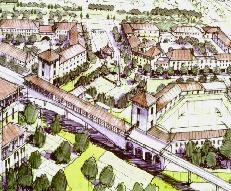
It's very interesting work, and includes some very cutting edge theories. For example it mixes market rate and public assisted housing together. Architecturally it's New Urbanist and consists of a couple of midrises (which are already completed) and about 6 blocks of nice town houses. It's got a great harbourside park and a bunch of social programs (ESL, GED, Day Care) There are also some interesting renewable energy projects: the midrise powers itself using solar power collected on the roof. I'm excited. More later.

Read more...

12.7.05

Highway Removal and a Proposal for Mpls

I felt that I had to write some on San Francisco’s Octavia Boulevard project. This seems like one of the most important projects in urban America right now, up there with the Big Dig and the work at the WTC site in New York. Ever since the Embarcadero Freeway in San Francisco collapsed in 1989, SF has put itself on a path to remove many of its highways. The project that is going on now will remove Interstate 80 and turn Octavia Street into a beautiful six-lane boulevard. Octavia will go from this:


Into this:


One of the most interesting parts of this project is that it was driven not by a forward thinking urban planner, but by the people of San Francisco themselves. Essentially, the voters have drawn a line in the sand, both figuratively and literally, in saying that there will be no highways beyond this line (in this case Market Street). In doing this, San Francisco has kept thier place on the forefront of American urban design.

Not that they are the first to remove an urban highway. Milwaukee, Boston, Portland, OR and New York have all also led the way. The unfortunate thing about these projects is that they shouldn’t have been necessary in the first place. All along the planners of the Interstate Highway System have known that they highways should not pass directly through cities. Norman Bel Geddes, the person most responsible for the U.S. Highway system said in 1939, “Motorways must not be allowed to infringe upon the city.” Unfortunately, unlike the systems in Canada and Europe, we did not follow our own rule. As such, our traffic problems have been, by and large, much worse then those of the other developed countries.

As we continued to develop new highways, we were shocked to find that no matter how big we built them, they still filled up. Our response has typically been to build more lanes and more highways. Unfortunately, we haven’t been willing to look at the statistics of what we are doing. Building more lanes simply brings more traffic. Some studies have shown that by adding a lane in each direction to a highway will cause increase in traffic that will require additional lanes within 4 years. To paraphrase a famous quote, adding more lanes to fix traffic problems is like loosening your belt to cure obesity.

So what happens when a highway is removed? When the West Side Highway collapsed in 1973 in New York, NYDOT conducted a study that showed that 93% of the car trips simply disappeared. The reasons for this are more sociological then technical. The easiest way to say it is that most car trips are simply unnecessary. When we decide whether or not to take a trip in our car, we, consciously or unconsciously, weigh what we know about traffic patterns and distances to decide if a trip will be worth it to us. If we know that traffic will be bad or that the distance is too far, we will postpone our trip or find a replacement trip that will be closer. We will find a doctor or used bookstore in our neighborhood instead of across town. Over time, people will even change homes or jobs to be closer to their homes if their commute becomes too difficult.

So, let’s imagine for a minute what this could look like in Minneapolis. Let’s turn four lane 35W into a six-lane boulevard along with an elevated light rail line in the middle starting at 62nd and running into downtown. Additionally there would be space for a block on each side of development.

The lightrail in this position would be fantastic. If you take a quarter-mile to a half-mile in each direction (let’s say Lyndale in the west and Chicago in east) and you have some of the most densely populated blocks in the Twin Cities. This would end up being more of a line for the population of Minneapolis then the Hiawatha line has been and it is already a proven transit way. I would envision a new transit station in the development blocks towards the end of the Boulevard (let’s call it Central Boulevard for the sake of giving it an easy name), maybe around 60th. All of the express busses that run on 35 could be discontinued and instead we could have several new bus routes to the suburbs running from the 60th St. Station. Additionally, the 18 bus that runs on Nicollet and the 5 that runs on Chicago and Portland (2 of the busiest in the city) could be discontinued. The central divider that would be home to the elevated lightrail would also be prime space for bike paths.

Although I’m sure that there would be many people who would complain of the longer amounts of time that commuting to Minneapolis would take, I’m pretty sure their would be little or no difference. As is, when I was working in Richfield and living downtown, I usually took city streets home, and can personally testify that it took about the same amount of time to get home. The problem with 35W is, once you are on, you are trapped. If I’m taking Nicollet and it’s too busy, I can change my mind and take Lyndale or Portland or Park or Xerxes or Penn instead. Central Boulevard would give people yet another choice, plus, with a divided roadway with dedicated turn lanes, it could support a slightly higher speed limit, say 40 mph, safely.

As far as the development blocks, I’d imagine continuations of the development that is already there. Namely, condos and apartment blocks closer to downtown; single family or duplexes (possibly row houses) farther out interspersed with retail all along. All along the boulevard there should be a height requirement of at least 2 stories, become 3 stories at 36th and 4 stories by Franklin. There should be on street parking all along the Central and a restriction of parking lots that are within sight of the street (however a pair of park and ride ramps would be nice, say at the 60th street Transit Center and at Lake, perhaps instead of that stupid Kmart). Wide sidewalks would give space for both pedestrians and street cafes. There could be several areas left open for parks, including an expansion and redesign of Kingfield Park, which already borders 35W. Another possibility would be routing the boulevard or the light rail a little bit farther west once it is past lake to put it along the east side of the Institute of Arts while keeping the other along 35W’s path to connect to the Honeywell and Wells Fargo developments in Phillips. The great part of all of this open space throughout the middle of the city would be the opportunity to create a showcase of architecture and design that would define the city, much like Berlin's development through the corridor that was left in the wake of the fall of the Berlin Wall, including Potsdamer Platz, the new Monument to the Murdered Jews of Europe, Pariser Platz and the new government buildings (Berlin also just edged out Rome to became the third most visited city in Europe, showing the potential economic benifits of this type of development).

This is all of course without regard to costs. I don’t claim to be an economist, so I can’t say for sure anything about costs. What I do know for sure is that a large portion of a smaller city's budget comes from building permits. The amounts of money that would come in from the development of 120 brand new blocks would definitely help off set some of the costs. Not to mention the new property taxes. We could also make it Honeywell Boulevard, Target Boulevard or General Mills Boulevard if we wanted to bring in a few million extra. Maybe even all three if we named it in different chunks. The development on the blocks would, of course be mostly private money, and the lightrail should be able to get transit subsidies. To take a look at Milwaukee’s work, the replacement of an elevated road way in downtown Milwaukee with a surface street was estimated at about a fifth the cost of what repairing the roadway in the first place would have cost (25 Million as compared to 120 Million). This isn’t to say that it wouldn’t be high cost, however one must weigh the potential for good to the city, an increase in tourism, better neighborhoods, a reduction in sprawl and increase in population and density within Minneapolis proper would all be possible results. Both Milwaukee and San Francisco have reported a revitalization of the neighborhoods bordering their smaller scale projects. It’s all a bit out there, I know, but this is a vision of what a city can become with just a little work.

Read more...

8.7.05

As a part of our goal of visiting more of Boston's tourist sites that we'd never been to, Jessica and I went to the JFK Presidential Library a couple of days ago.


The library is in Dorchester, which is the neighborhood just south of Southie, on the campus of UMass Boston. It's got a great location overlooking the harbour. J and I have never lived anywhere with an ocean before, and we were kind of surprised how inaccessible the ocean actually is from Boston. I kind of expected it to be more like Lake Michigan is to Chicago, but Dorchester actually has some nice views. The library was designed by IM Pei, the architect who did the Hancock tower in Boston, One Bank Place in Minneapolis, the Holocaust Museum in DC, The Deutsches Historischen Museums in Berlin, the Rock and Roll Hall of Fame in Cleveland, and the renovation of the Louve in Paris, to name a few of his more famous works. The library falls right in the middle of his career, and although I don't like it as much as some of the newer building, it's a testament to the forward thinking of his design how it looks as if it would have been built just last year.

More so then the facade, it's the interior and the display spaces that are really interesting. It's very much the twenty-first century museum. Instead of having lots of displays with stuff to read, each section of JFK's presidency has a few thinks to read and look at, but at the center there will be some monitors that are showing video from the time. For example, in the part about the election, you actually had video of Walter Cronkite reading off election results. It's the type of place that a teenager (in saying teenager, I actually mean adults who can't understand why I would go to a museum for fun. you know who you are.) wouldn't get bored or overwhelmed. My favorite area was probably the temporary display of gifts that had been given by foreign heads of state. There were some wonderful pieces of silver from the Shah and the King of Cambodia as well as several beautiful African tribal masks. Also, out of the twenty or so displays, there was one devoted to the Peace Corps, which I think is really one of JFK's best contributions, so I was glad to see it there. There were also films about JFK's life prior to the presidency and on the Cuban Missile Crisis.

Overall, the museum is worth a stop if you are in New England. It's one of the better ones i've visited.

I also just finished uploading a bunch of photos from my last trip to canada to flickr. It's going to take me a few months to upload the entire trip. You can click the photo below to take a look. I should also mention that it was Mikee Caron who took most of these photos.

Read more...

7.7.05

Sorry about not posting for awhile. I lost my internet connection in a storm and it took awhile to get someone out to fix the wire.

So, yeah, had a great time in Minnepolis. As someone who studies city planning, it is kind of fun to have a place that i know so well, yet that I visit so infrequently that I can see what development has been going on. I see a lot of good signs that traditional planning is winning in the city, for example, boulevards are actually boulevards, and the landscaping along Hiawatha shows a traditional street layout. All three of the new developments in Loring park looked great. The construction along franklin was a good start, but there is still a lot of infill that needs done. The development along Washington also looked like it was doing well. The lightrail was also extreamly busy everytime I used it, which was great to see. Build more!

Who knows, maybe in 15 years minnepolis will be the type of place i'd be willing to live again.

Also, contrats to Luc and Michelle on the wedding and Ryan and Bethany on the baby!

Read more...

21.6.05

Mags

All the magazines came in the same day yesterday. Here's what i know so far:

The Economist: The housing bubble is about to burst. I've been saying this for awhile, but it's kind of weird when a main stream (even slightly conservative magazine) says so. The Economist kind of says the world is going to end, but here is what should happen from an urban development standpoint (it's not the first time this has happened): much like farmers, suburbanites (and city dwellers with large lots) will begin to reallize that the land thier property (or business) sits on is worth more then the property itself. They will either develop it further themselves or sell to developers who will rebuild at higher density. The urban and suburban infill will bring people back from the outer suburbs to the city and first ring suburbs, especially as property gets cheaper (both for companies and individuals) and gas prices continue to rise. It's terrifying for people who thought thier houses would be thier retirement fund, but it's actually a very natural part of city development.

Metropolis: Boing bulit a new "democratic" workspace. I'm not sure what that means yet, because I haven't read it. I think it has to do with glass curtain offices like the Daimler Chrysler headquarters in Berlin.

Foriegn Affairs: Avain flu is going to kill us all. No seriously. According to the Center for Disease Control and Prevention, if the virus mutates to be transmited human to human, 18 million Americans would die and well over 1/3 would get sick (that's with only a 20% mortality rate, in actuallity, the death rate so far is over 50%). They also talked about the spanish flu outbreak of 1918-19. 6% of the US population died and the average life expectancy went from 55 in 1917 to 37 in 1918. Fricken A.

I haven't started reading National Geographic Traveler or Foriegn Policy yet. I wish they would spread out over the month a little more.

Read more...

15.6.05

I've had nothing to write about recently, so here is a tidbit from the most recent book I’ve been reading:

The suburbs in California grow by a space equal to that of the entire state of Massachusetts every ten years.

Anyway, I've been spending my time lately trying to find a part-time job or internship within my field so that I can start getting some professional experience before I graduate. I'm really hoping to get into a really good grad school and I know that some good experience will make me stand apart. These are my favorite two things I’ve applied for so far:

1. A job for a part-time planner at a consultancy in Lexington that specializes in zoning law.
2. A research fellowship with a think tank. I'd be doing research regarding a Hope IV grant for the revitalization of a housing development that happens to be in my neighborhood. I'm hoping since I have the neighborhood in I'll be more likely to get the position.

Naja. I'm looking forward to seeing you Minneapolis kids soon. What's going on with the Twins game? Someone call me or something.

Oh, yeah, I'm also now an official member of the American Planning Association, so that's pretty cool.

Read more...

7.6.05

The District

DAY ONE:

I think this is my fifth or sixth trip to Washington, which puts it near the top of the list of time spent in cities that I’ve never lived in (with Chicago and Rome). That’s kind of strange for me, because, to be blunt, it’s never really been my favorite place. Don’t get me wrong, I like DC, just not the way that I like New York or Chicago (or Rome or Amsterdam).


I love DC’s planning. L’Enfant’s grid plan mixed with the diagonal boulevards and circles is probably the best grid plan in America. It manages to mix logic with beauty in a way that upper Manhattan or Chicago just don’t. Unfortunately, the architecture doesn’t carry it through. Despite the grandeur that DC’s great buildings exude, the classical styles are just kind of bland. This is carried to an even further extreme in the office buildings. They are large, imposing and uninspiring. It’s understandable though, it’s a democratic city, and when you try to please everyone in planning and architecture you end up with substandard fare. Washington is the vanilla of American cities. Everyone can get by with it, but most people would like it if it were spiced up just a bit.

Anyways, we got $50 round trip tickets, and there are some new museums that I really wanted to see, along with a surprisingly good brand-spanking-new baseball team, so how could we really pass up a few days? We flew in to Dulles early yesterday (a word of advice: fly to Reagan-National instead if you can. Besides the fact that Reagan was less evil then the Dulles brothers, which says something, it is way easier to get out of the airport and into the city). We’re staying in a run down flophouse in Dupont Circle above a bar that proclaims the most different types of beer in the world. Side comment: It is so weird seeing people smoking indoors. Even the dude checking us in to the hotel was puffing away.

First stop was the National Zoo. It was all right. I was hoping for one of those older urban zoos like Como or Lincoln Park where you can actually see the animals, but it was more like the Minnesota Zoo where you have to really try. They did have capybara and cavies (wild guinea pigs) so that made up for it. It was also freaking hot though, and we both got a little burned.


In the afternoon, we went to the new International Spy Museum, which rocked so hard. I think it’s replaced the Vatican’s Modern Religious Art Museum as my favorite. All the way through the museum, you got to spy on the people behind you with listening devices and crawling through ductwork and the like. There were also lots of interactive displays where you could identify people undercover and look for signs of dead drop sites and stuff like that. So cool.

We had a late dinner in Chinatown, and then it was off to bed. End day one.

DAY TWO:

We decided to start off the day with a walk around all of the national monuments, since there are a couple of new ones since the last time we were here. Jefferson and Lincoln were both pretty much as I remember them. I’m not a fan of the concept of the temple as a memorial. It creeps me out a little bit, but it is still hard to not be moved. I also enjoyed Jefferson’s memorial more now that I’ve traveled more and was able to pick apart the architectural bits that they took from elsewhere; for example, the roof is a smaller copy of the Pantheon in Rome. I loved the FDR memorial. I found it very fitting. The Korea and Vietnam memorials I had seen before, but they are still very moving. The new World War Two memorial was a stark contrast. Vietnam and Korea are both dark marble and rather small. The statuary at Korea shows a tiredness and fear, and the way the Vietnam is sunk into the ground reflects the role the Vietnam played in America’s history. World War II is huge and white and exuberant. Jessica pointed out that it seemed very victorious.


In the afternoon, we went to the new Museum of the American Indian. I loved it. I’m part Cherokee, and I’ve always had a bit of a thing for Native American history. The architecture was stunning. Probably better then any of the other Smithsonian Museums; it really fit the subject matter. The exhibits were also very good. There was one side that showed several nations history and then on the other side they showed the lifestyle and belief systems of other nations. There was also an exhibit of modern native art. Jessica and I bought a piece of Inka pottery.

In the evening, we went to RFK stadium for a Nationals game. I like RFK. We had seat just above home plate, which is usually better then we get, but it was cheep. It reminded me of old-timey baseball. The beer was still in bottles (made of glass!) people smoked inside, food didn’t cost an arm and a leg and the crowd got excited when people hit doubles. It was a good game too. The pitching on both sides sucked, but that always makes for an interesting game.

FINAL DAY:

In the morning, we went to the Natural History Museum. It had been several years since I’d been, and they’ve been doing some remodeling. About half of the displays were close while they were being redone. The new ones looked great, the old ones not so much. One of them actually had wood paneling. I felt like I was in a rumpus room from 1965. The new mammal hall looked really nice. I remember last time I was there everything was all dusty and dark.


We had lunch at a bistro at the National Sculpture Garden and then went to a couple of the art museums, The National African Art Museum and the Sackler Gallery. The Sackler Gallery is all Asian art, mostly from the Middle East and China. There was a very interesting display of stuff that showed how Iraqi and Chinese art had affected each other as they started trading. You’d start with this white bowl from China then the next one would be a white bowl in the same style with simple blue calligraphy from Iraq and then there would be a white bowl with a little more complex patterns from China and so on. It was very interesting.


The African Art Museum was also quite good. My favorite exhibit there was of life items (you know, stools, pipes ect.) from across Africa. The curators of both museums were great. They were housed in identical buildings, however the African museum was very warm and comfortable. The Asian museum had more of a stark, simple exquisite beauty. I highly recommend both.

Read more...

2.6.05

New Urbanism and the Emerging Church

A few weeks ago, I was reading the new Metropolis and there was an article that got me thinking, so I thought I’d make a post about it and see if I can get anybody else’s thoughts.

Metropolis Magazine


There was an article titled “The Manchurian Main Street” talking about New Urbanist shopping districts. For those of you who don’t know what New Urbanism is, it is a style of planning that “promotes the creation and restoration of diverse, walkable, compact, vibrant, mixed-use communities composed of the same components as conventional development, but assembled in a more integrated fashion, in the form of complete communities. These contain housing, work places, shops, entertainment, schools, parks, and civic facilities essential to the daily lives of the residents, all within easy walking distance of each other. New Urbanism promotes the increased use of trains and light rail, instead of more highways and roads. (from the new urbanism website).” To break that down a little, they seek to return to a time when development was a. multi-purpose b. easy to get around with out cars and c. aesthetically pleasing. For examples in Minneapolis, you can go to Grand Place on Excelsior Blvd or to “Main Street” in Maple Grove. Block E downtown also uses some New Urbanist architecture, but fails to follow through because it lacks multi-use tenants and also does a poor job of connecting to the street level. In Boston, there is a development near Beacon Street in Brookline and a shopping center called Mashpee Commons on the Cape that are good examples.


I’ve always been a fan of New Urbanist planning. In fact, when I choose a neighborhood to live in, the ideas behind New Urbanism are what I look for. I want to be able to walk, have public transit, shop and interact with my neighbors in my neighborhood. As I do not (nor do I plan to in the near future) own a car, these things take on even more significance. The only major difference is that I have always chosen to live in actual historical districts. If you take the average year that the building was built in my last three apartments, you get 1887. Despite the fact that New Urbanism seems to be the best planning out there right now, you still get the fact that they are only trying to copy something out of the past. To quote the article in Metropolis, it’s “a strategy that doesn’t solve the problems we’ve created so much as teaches us to forget them.”


I also see parallels between this and the post-evangelical church movement. Essentially, we are reaching back to our imagined past to try to overcome the real problems that we’ve encountered in mixing Christianity with modernism, however, the problem is the same, we’re not finding solutions to our problems, we are just going back to a time when we can forget that there were problems.

My question is, is this necessarily a bad thing? Like I said, it is all of the proponents of New Urbanist planning that I look for in a neighborhood. Does it matter if it was built in 1860 because it was the cutting edge or in 1990 because people wanted to forget the last 70 years of bad planning? But I have to ask myself, if we progressed from good planning in 1860 to bad planning in 1960 or from good Christianity in 1480 to bad Christianity in 1980, what is to prevent us from making the same mistakes again? Modernist planning and Christianity both grew out of trying to correct the problems of what came before, if we revert back, won’t we just be doomed to repeat the cycle?

---
on a completly unrelated note, I just rearanged my links to be from people who post the most to people who post the least. I also added Dugan, though let it be know that I do not support his content. I always think its good to hear both sides of the story...both right and wrong... and at least he's thinking, which is more then you can say for most people.

Read more...

  © Blogger templates The Professional Template by Ourblogtemplates.com 2008

Back to TOP