5.2.07

Guthrie Theater (1962-2007)

Destruction of Old Guthrie Theater
Photo by: Paytonc
I didn't get time to write much about my recent short trip to Minneapolis last month. I did, however, want to write about disappointed I am that they ended up tearing down the old Guthrie Theater. It's beyond my comprehension that a building that some architecture historians said was one of the 500 most important buildings in America in 1996 would be knocked down just ten years later.

To me, this really shows that we are entering into a time when a lot of great modern architecture is in danger. They aren't quite old enough to be considered historical by the preservation people. The Guthrie, for example, was built in 1962, which means it was just five years short of the fifty years that a building generally needs to be called historic. Additionally, a lot of people don't see anything important about the modern style itself. A few years ago when I was talking about the need to save the Guthrie, my father-in-law commented that it was just a glass and steel box. I realize that there is probably some greater meaning here about modern architecture's failure to connect to the masses or something, but still.

Ralph Rapson and Associates built the Guthrie in 1962. Rapson held his practice in Minneapolis and was head of the University of Minnesota Architecture School. Before that he also ran the New Bauhaus in Chicago and had studied under Eliel Saarinen. His two most important buildings were in Minneapolis. The first was the Guthrie, the second Cedar-Riverside housing complex.
Minneapolis, Minnesota
Unfortunately, one of those buildings is now gone. He also designed the US embassies in Sweden and Denmark.

To me this is an important reminder that we (architecture and design students or enthusiasts) need to stay on top of this kind of stuff. The current endangered building in Boston: City Hall. But more on that later.
Boston, Massachusetts

Read more...

1.2.07

We just got these in at work and they're pretty neat. They're little travel guides from Phaidon and Wallpaper Magazine that focus on deisgn and architecture stuff (much like Wallpaper itself). They're pretty cheap, too.
Wallpaper Mexico cityWallpaper New York City
Not quite as cool as the new Moleskine Travel Journal, but what is?

Read more...

29.1.07

Homework
So, the semester has had kind of a slow start so far, but I'm finally getting into the swing of things. I'm taking Principles of Design at Wentworth, which is great. I was just starting to get comfortable in 2D, so of course we are jumping right into building 3D stuff. I've been using SketchUp a lot for computer modelling, but I still have to put this together in real life. Should be pretty cool though. I really enjoy it.

I've been doing plenty of reading to begin working on the thesis. I'm thinking I'm going to start writing as soon as possible. I've heard from a few people that that is the way to go. I have done one other paper that was this length, so it's not the worst. I've been looking forward to it for quite awhile.

In other news, I finally switched to New Blogger. I kind of like the labelling thingy, but I'm not happy about having to have a Google ID. Whatever. This isn't really interesting. I just felt like writing. Yeah.

Read more...

23.1.07

Oscar Time Again

J and I are pretty big film buffs. We see almost a movie every week or two most of the time. For the past three or four years, we've been trying to see all of the films that get major Oscar nominations before the awards, and typically, it seems like we've got a ton still to see once the nominations come out. As an aside, I know there are probably people out there that are rolling their eyes about the oscars... yes, I know that they are over commercialized, and that there are other good films out there. Personally, I see the commercial aspect of film making one of the artistic challenges that needs to be overcome. It's like architecture; there is an artist in there, but he has to wait for someone to foot the bill, and his work is always molded by commercial concerns. It's just part of the nature of the art.

Anyway, usually we've got a lot to see, but this year we did really well in advance. I think it helps that there were a lot of really good movies this year, while last year kinda sucked a little. The Departed, Little Miss Sunshine, An Inconvenient Truth, Notes on a Scandal, Pan's Labyrinth, Babel, Children of Men, Last King of Scotland and Blood Diamond were all really good. oh yeah, and Borat...

My personal favorites were Children of Men, Pan's Labyrinth and Babel (all of which were Latino directors by the way). But really anyone of those ones I just named could probably be Best Picture in a less competitive year.

Letters From Iwo Jima was a little disappointing. I think I built it up too much. And Streep is always a good actress, but I didn't really feel that there was anything at all Oscar worthy about Devil Wears Prada. I would have liked to have seen the little girl from Pan's Labyrinth (Ivana Baquero) on that list.

We still need to see Volver, Little Children and the Queen for sure. I'd also like to see more of the foreign ones (especially the German one and the Canadian/Indian one) and the documentaries (although I don't think I can watch Jesus Camp, to close to home).

Read more...

22.1.07

This is the Phoenix' recent article on the 27 worst things about Boston. Some I agree with, some I don't. My favorite on their list: DEEP-SEATED PAROCHIALISM! My favorite not on their list: 3 non-corporate coffee shops for a city of 600,000. And only one has free wireless. Grrr.

Read more...

18.1.07

Oh, thank god. Dwight is still around. I think I lost sleep over it last week.

Read more...

17.1.07

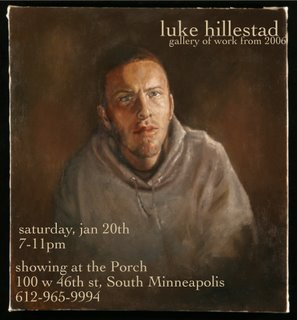
Luke
Though I suppose that there are probably very few people who read this who wouldn't know about this already, I just wanted to point out that my friend Luke just put up a new website featuring his work as a painter and that he has a show coming up in Mpls.

One of the things that I really love about being friends with so many really talented people is how much you can really understand about them from the type of work they do. I think that art, especially visual art, gives you a chance to see things from another persons perspective in a really interesting way. To put it another way, I think that every person sees and understands the world in a different way. Visual art gives you a chance to see the world that others see.

For example, Brother James sees nature in a way that I've never been able to. His landscape photos show something that I wouldn't have see even if I were there...
Ben

Likewise, J's photos capture people in ways that I never see them...
DSC01909

Luke's portraits, most of which are of people I know, show people in a very beautiful, very organic sort of light. When I spend time looking at them, I feel like I'm getting a very different view of people that I've know for a very long time, which isn't something you get to do every day.

Hopefully others enjoy them as much.

Read more...

14.1.07

Marxist Humor

Montréal, Québec

Read more...

21.12.06

The Best Architecture, Planning and Urban Affairs books of 2006

I put a lot of thought into the order of this list, but please remember that it reflects my personal interests as much as overall goodness of the book.


Urban Nightmares: The Media, The Right, And The Moral Panic Over The City by Steve Macek
This is my overall favorite of the year. It rocks (and it's U of M press). Macek takes a long look at film, advertising and the media and the portrayal of the city, as well as the way that the right has used those ideas to gain power in the suburbs over the past 50 years by creating an us vs. them that left the perception of urban dwellers as being poor, non-white, and immoral. One of the books strengths is how often it lets the right speak for itself. Like the wonderful suggestion that we must, "abridge to an appropriate degree the freedom" of urban dwellers. Wonderful stuff.


The Destruction of Memory: Architecture at War by Robert Beven
This is also a fantastic book. It's about the targeting of architecture during episodes of ethnic cleansing. There are big sections on Nazi Germany, the Balkans, Israel/Palestine, and Iraq. My thesis work is going to be on the ways that planning and architecture can reflect and promote national identity. Well, this is the dark side. Mosques into churches. Priceless works of art destroyed along with civilian populations. History physically erased.


Planet of Slums by Mike Davis
Mike Davis is one of my favorites and this is a great topic. Davis has to be one of the most intelligent people writing now. The shear amount of information can be overwhelming at times, but at the same time it isn't a difficult read. In this book, he examines the growth of informal housing throughout the world (and for those who think this is a third world problem, there are areas of the US that have ever growing shantytowns) and some of the responses to the problem from groups like UNHabitat or economists like DeSoto.


Cities by John Reader
Reader presents the history of cities from a natural perspective, which is really quite fascinating. He also addresses the whole chicken and egg problem of urban development in a very good way. Did cities begin because people started producing agricultural surpluses or did people start producing agricultural surpluses because cities developed? Reader makes the case that archeological evidence seems to say that people grouped together first and foremost of religious and defensive reasons and developed agriculture to support that arrangement.


The High Cost of Free Parking by Donald Shoup
Now, a six-hundred plus page book on parking is not going to be everyone's cup of tea, but if you are interested, this book is interested. It's really pretty amazing how a seemingly little public policy decision like parking minimums shape so much of our physical world. This book has given rise to a whole generation of "Shoupistas," so hopefully we'll see a lot of local policy changes in the near future. This is one area where planners can really take the lead.


Cosmopolis II: Mongrel Cities of the 21st Century by Leonie Sandercock
Sandercock teaches at UBC now, but she's spent a long career throughout Australia and Canada studying the post-colonial city. This book is about the 21st century city, which, to her, means the diverse city, the demilitarized city, and above all, "I don't want a city where my profession - urban planning... act(s) as spatial police, regulating bodies in space..." Sandercock is also married to John Friedman, who wrote Planning in the Public Domain, which is also awesome.


Come Hell or High Water: Hurricane Katrina and the Color of Disaster by Eric Michael Dyson
As promised, one more book on Katrina. Dyson's book has wonderful statistics on rates of car ownership and access to automobiles, a great timeline and some wonderful thoughts on Kanye West's "George Bush doesn't care about black people" comment. Dyson suggests that it didn't mean that Bush personally doesn't care about individual black people but rather that the Republican Party as a whole has written off the possibility of winning Black votes and therefore directs it's aid toward people who may vote for them and in that way collectively doesn't care.

Runner-up books worth reading:
The Edifice Complex: How the Rich and Powerful Shape the World by Deyan Sudjic
The Architecture of Happiness by Alain de Botton
Neo-Bohemia: Art and Commerce in the Post-Industrial City by Richard Lloyd

Read more...

17.12.06

The Best History Books of 2006

Back to the Lists. I think I've got two more in me.

List Three:

The Best History Books of 2006
And again, it's a little hard to nail down dates sometime, but I think all of these came out in either hardcover or paperback this year.


Finding George Orwell in Burma by Emma Larkin
I read this book all the way through in one sitting (an airplane ride actually). The author (I think it's just a pen name) travels through Burma (Myanmar) in search of locations associated with George Orwell's time there. Orwell was born in Burma and his first novel was set there (Burmese Days). She also makes interesting comparisons between the current government and the books 1984 and Animal Farm. It's a quick read but very moving.


Imperial Reckoning: The Untold Story of Britain's Gulag in Kenya by Caroline Elkins
This was the Pulitzer Prize winner in Non-Fiction this year. I always try to read the Pulitzers, as they tend to be so well written. It was a major bonus this year that it also happened to be about Africa. Although it's about the time period of the Mau-Mau insurgency in Kenya, it focuses much more on the lives of the people who weren't fighting. Basically, since all the men were fighting, the British rounded up all of the women and children and placed them in horrible camps where torture, rape and death were daily occurrences. Many of the same ideas (and people) were involved in similar projects with the British in Malaysia and the Americans in Vietnam. It's an excellent academic study, but also manages to be readable and emotional.


A Great and Noble Scheme: The Tragic Story of the Expulsion of the French Acadians from Their American Homeland by John Mac Faragher
In keeping with the Ethnic Cleansing theme, I spent a lot of time in French Canada this year and also did a lot of reading about Canada's French speaking peoples, the Quebecois, the Metis (the French-Indian living in the west), and the Acadians, who originally lived around the Bay of Fundy (today's New Brunswick and Nova Scotia) but were expelled by the governors of Massachusetts and Nova Scotia just before the American Revolution. This is the story of the expulsion. Like most Ethnic Cleansers, the perpetrators of this crime kept excellent records (in their minds to show the justice of their actions).


The Acadians: In Search of a Homeland by James Laxer
This book, which has only been published in Canada so far, tells the next part of the story. It shows how the Acadians scattered to become Louisiana's Cajuns as well as reconstituted in northern New Brunswick to become a political force there. It's a pretty fascinating look at how a people group can survive culturally without a homeland (kind of like the Latinos in Aztlan?) Hopefully an American publisher will pick it up.


The People's State: East German Society from Hitler to Honecker by Mary Fulbrook
I have to admit that I haven't finished this one yet, but it's been really good so far, so I had to add it to the list. Fulbrook is a sociologist from the London School of Economics. While discussing the DDR with many of her students who had grown up there, she found that it didn't fit her ideas of what Communist dictatorship was supposed to be. She gives the idea that we need to look more closely at how power was actually used instead of just using terms like Democratic or Authoritarian. Basically, she thinks that the DDR was what she has termed Participatory Authoritarianism, which basically means that although there was an authoritarian power structure, people were still active in decision making, especially at the local level.


Pol Pot by Phillip Short
I also read a lot this year about Southeast Asia, but most of the books were pretty classic. This is the only one that was actually published recently. Short does a very good job of telling the story of the Khmer Rouge leader and also has a very interesting idea that some of the responsibility for the Khmer Rouge period belongs on the shoulders of the French education system and the way that they still unflinchingly teach that the blood and gore of the French Revolution (which, as a percentage of population was actually the bloodiest revolution in history, far more then the Russian, Chinese or even Cambodian) was necessary for the creation of modern France.


The Great Earthquake and Firestorms of 1906: How San Francisco Nearly Destroyed Itself by Philip Fradkin
I read this one for my Urban Disaster class last summer. When I recommend it to people at work, I always tell that that if you want to understand what happened in New Orleans, this book is the best place to start. It shows, in great detail, how disasters effect the poor unevenly and how minorities are often mistreated and left out of disaster recovery. It was quite shocking how little things have changed between 1906 and 2005. There will be more on Katrina in the next list.

The Final List: Architecture, Planning and Urban Studies

Read more...

  © Blogger templates The Professional Template by Ourblogtemplates.com 2008

Back to TOP